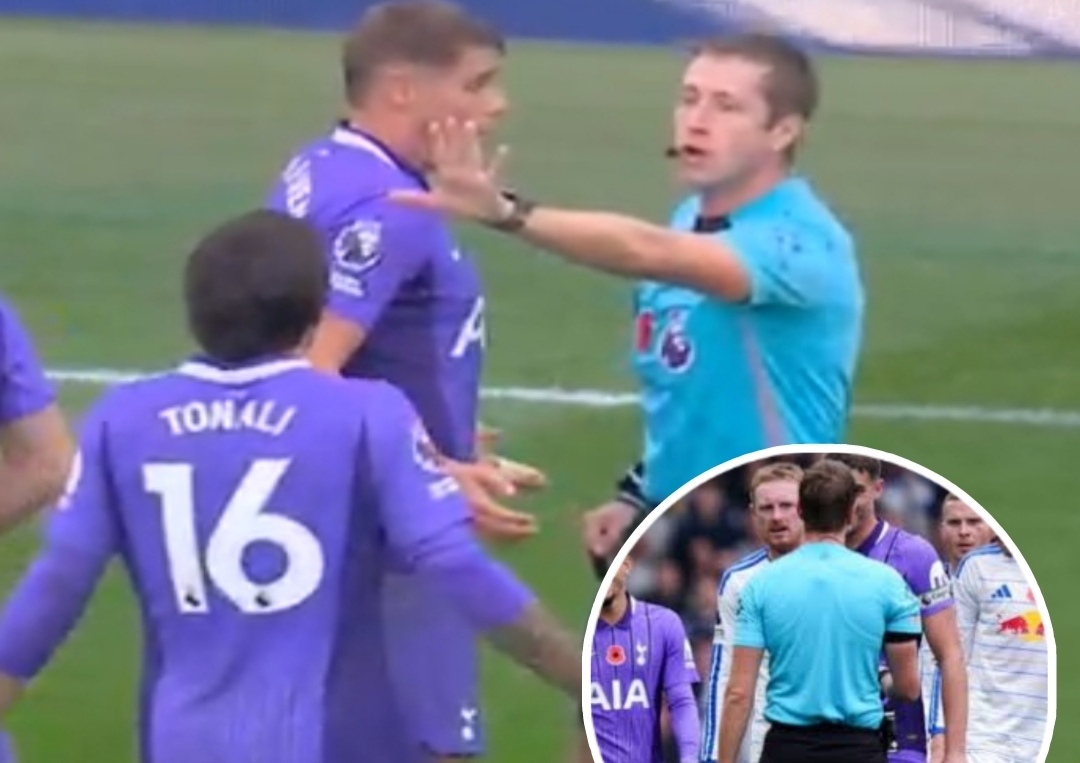
Tottenham’s trip to Elland Road to face Leeds United has turned into a row over the officiating. Referee John Brooks and the two VAR officials are facing mounting criticism over a tackle by Jayden Bogle on Mathys Tel. Many Spurs supporters are angry that the defender stayed on the pitch. They point out that Brooks was not the only one to look at it, since the VAR team also had the chance to review the challenge and still no red card came.
The tackle drew attention straight away, and plenty of Tottenham fans felt it was serious enough for a straight dismissal. Bogle carried on, which frustrated players and supporters alike, and the fact that the review changed nothing only made it harder for them to accept. For fans who think it merited a red, the outcome simply made no sense.
Brooks is at the centre of the debate as the man in charge on the pitch. He was the one expected to judge whether the challenge crossed the red-card line, and his decision is now under heavy scrutiny. Supporters want to know what he saw, how he read the tackle, and whether the VAR officials gave him the help he needed. Controversial calls are part of football, and they rarely lead to action against officials, but when criticism is this widespread, questions about the reasoning are only natural.
The VAR officials are under the microscope too. The system exists to correct clear and obvious errors in key moments, including possible red-card offences, so when a review leaves a disputed decision untouched, the blame spreads beyond the referee. Fans are asking whether the footage was checked from the right angles and whether everything relevant was properly weighed. Still, there is a difference between criticism of a decision and proven wrongdoing, and nothing currently suggests Brooks or the VAR team have been disciplined, suspended or found in breach of any rules.
For Spurs supporters, the real worry is that their side may have been put at a disadvantage. A red card can transform a match, opening up space, shaping tactics and changing how both teams play the rest of the game, which is why fans react so strongly when they think an opponent got away with one. They want disciplinary calls judged objectively and the same standards applied to every club and player. The row has also reopened broader doubts about VAR, which can help officials revisit big incidents but cannot remove every disagreement or satisfy every supporter.
The question of consequences is now a big talking point. If concerns are raised formally, the relevant authorities could be asked to look at the incident, including Brooks’s original judgement, the VAR process and whether the correct procedures were followed. A review would not automatically mean sanctions or loss of position, though. Premier League referees and VAR officials are assessed on their performances, and any outcome would depend on what the authorities find. Supporters should be wary of claims that punishment has already been handed out or that formal action is confirmed.
Even so, the episode has left the match officials in an uncomfortable spotlight. It shows how one contentious decision can dominate conversation long after the final whistle, with Tottenham fans wanting answers and the discussion showing no sign of fading.
Whether the club takes the matter up formally or just asks for clarification, the demand for consistency in Premier League officiating is unlikely to go away. The key question remains whether the challenge should have been a straight red card, and until fans get a convincing explanation, the argument will keep running.